A website for bros who use bitcoin.
User story:
What if I could buy local organic groceries from friends in my mountain community, or neighboring communities, all peer-to-peer, and my bros delivered it on mountain bikes from a ‘satellite distribution hub’ (perhaps their garage or spare room) a couple of streets away. And when I’m hungry, I can order the best burger in town, from a nearby dark kitchen, for a great price… and because it’s snowing it’s delivered by one of my bros in a 1500 Ramcharger PHEV (there’s free recharging in BC).
And then after a few months… we build a main operations hub in our community. Big open hangout spaces with gym gear, accommodation, and coworking stations. Some have studio space for broadcasts and AV production and a community streaming channel. They’re tactically located and pretty spacious so we can restock the satellite hubs and optimise fulfillment.
And each community operates their own customised Co-Operative model; we can select from open-source DAO templates (if we want to)… but most importantly, everyone contributing to the project shares in the value that we’re creating… drivers and riders get paid fairly, as do the farmers and other producers.
The website could be a kind of Grand Freedom Bazaar, organised into category sections, each containing a curated selection of highly compelling value propositions. Sellers will be permissioned (Pubky whitelisted), so as to maintain product and content quality, prevent cringe, and encourage stalls that are curated to our target demographic.
Step 1) Bros to use bitcoin to pay for things, because doing so is an obvious value proposition.
Step 2) Bros influence their communities to use bitcoin.
A few proposals for product category sections are outlined in the following pages; not necessarily in order of priority/viability.
It’s envisaged that each section will be a PWA applet on a subdomain, with a persistent menu-bar that allows navigation between sections. The menu bar can be driven by an admin panel with granular switches to show or hide product category sections (i.e. subdomains) for each country. The menu bar seen by users will then be based on the country of their IP address. This will allow for optimised organizational and legal entity structuring, controlled roll-out, planned maintenance,and agile development.
It’s proposed that the front page of the website will be a location based (geo-proximity ordered) permissioned P2P marketplace [directory]. A site-wide persistent top-menu bar will allow navigation between sections [i.e. subdomains]. An algo-driven carousel (or similar) could be placed on the front page to showcase products/services from other sections.
Disputes & inquires could be initiated and handled via a Keet group chat between the buyer and seller and [optionally] a helper bot. Either party may ask the helper bot to escalate a dispute / inquiry, to – for example – a geographically local marketplace co-coordinator or category specialist.
In addition to buyers and and sellers leaving mutual reviews, ‘thanks for the trade’ tokens may be signed and sent between trade counterparties. A visual icon-bar horizontally filled up to 5 stars (without showing a number) could be used for seller ratings while mitigating de-facto social credit.
Users may choose to burn their keys and start over, albeit with an empty web of trust. IP blocking, key blacklisting, pay-for-signup etc. can be used to help prevent spam. A referral, or member-get-member (invitation) feature could be used to prevent fraud and abuse. Depending on the magnitude of the value proposition, ‘Invite Only’ may generate more hype. There are also opportunities for gameification (i.e. Revolut provides cash or ‘Revpoint’ bonuses to customers who refer new members who spend >y dollars ).
While many sellers will choose to list products with an anchor price in local currency (reflecting fixed supplier & business costs) with dynamic conversion to bitcoin, nudge theory (reduced commissions, prioritized listings etc.) can be used to incentive sellers to either:
- Upload products priced in bitcoin. This is more likely for products with lower or less volatile input costs (i.e. locally laid organic eggs), or…
- Upload products priced in fiat, with a ‘Smart Price’ check-box to automatically price-snap up or down to a round number of sats. (i.e. Beekeeper in Devonshire lists XL jars of manuka honey at £12.50 which is the equivalent of 4,609 sats and chooses to round to 1-significant-figure, resulting in a less-volatile selling price of 5,000 sats )
Bitcoin native pricing, and rounded pricing, should help to establish a Bitcoin Standard; it’ll help regular market participants to develop approximated memory-recall of round amounts of bitcoin, with respect to local currency. We can designate ‘flagship’ products as those products with [mostly] non-market-linked marginal input costs. i.e. Eggs laid by free range chickens that eat grass and bugs. By using gentle nudge methods to discourage sellers from changing the price too often, we will help support a ‘bitcoin standard’.
Users may (optionally) choose to commit a signed anonymised record of their transaction to a bitcoin native, open source, real time, price data aggregator that’s searchable, optimised for micro-trading, and with API connectivity…
Move aside Bloomberg… make way for… DogeLoaf

Dogeloaf concept: Live price for EGGS in UNITED KINGDOM (sats)
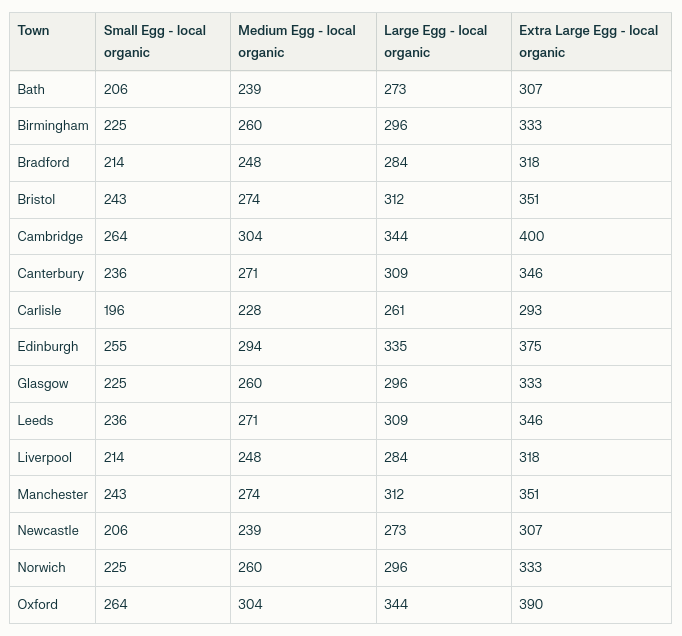
… but more like this 😀

And with ‘popular item’ contact templates which include weight, quality, delivery, etc.
- Sourdough loaf (750g ± 50g baked weight)
- Organic eggs (small, medium, large, extra large)
- Classic Beef Burger – 250g (Alberta lean beef) delivered warm in Banff village
- 1 liter fresh raw cow milk (no container)
- 250g multi-floral honey (glass jar)
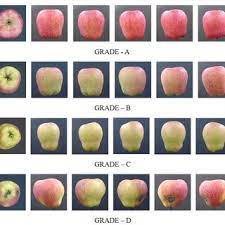
- 1Kg Cox apples (Loose Grade C)
Established commodity grading methods can be used.